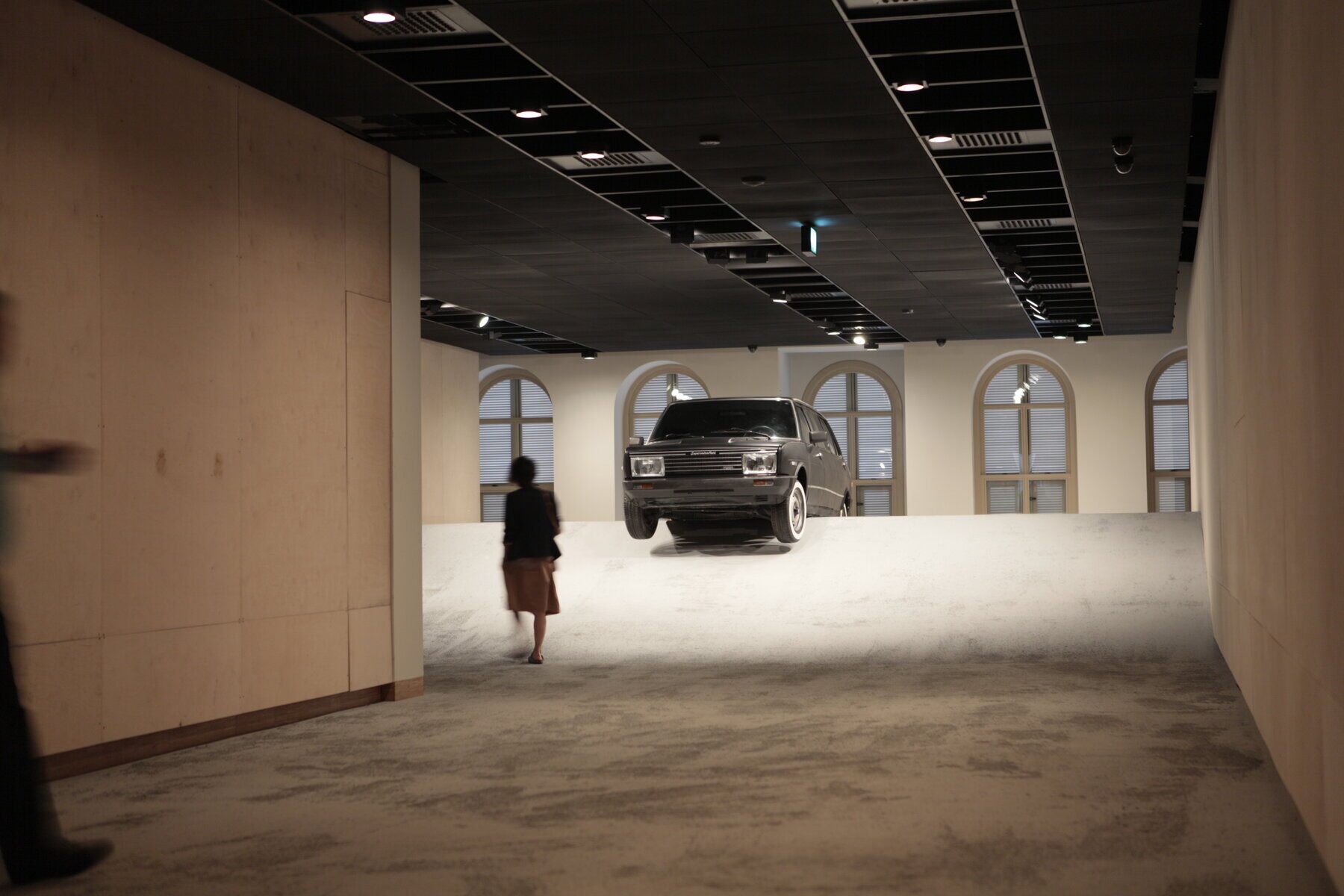
Across the Slope: Ahmet Öğüt
Modern Essays investigates different aspects of modernism, the effects of Westernization, and the notion of progress in cultural practice via singular works and positions. Discussions and supplementary programming accompany these projects.
The “civilization project” of the Turkish Republic not only impacted cultural and artistic production; it also created a new framework for architectural practice, design and urban development. Examining visual and spatial production in Turkey, Modern Essays explores ideals of modernization in relation to constructed environments, design and the comparative material reality of different eras.
Turkey’s modern artists mediated the demands of a top-down, photogenic Westernization; they were both its model subjects and its initiators. From the 1909 Second Constitutional Era, when minority and Levantine professors at the Academy of Fine Arts were removed from their posts, to the days of Şişli Studio, when the 1914 Generation (artists who studied in Paris until the outbreak of World War I, also referred to as the Turkish Impressionists) began producing war paintings, to the establishment of the Gazi Teacher Training Institute in the new capital, Ankara, and the “Revolution Exhibitions” that ensued, artists served as engaged intellectuals, underscoring the ideological precepts of the Turkish Republic. Delegated to carry out a “civilizing mission,” these cultural producers were not so far removed in their approach from a blend of Soviet social realism and the culture of the National Socialist era.
By the 1940s, this zeal to mold a new ideal was largely abandoned. After World War II, the necessity and urgency of the assumed cooperation between subject and state waned. The situation became more ambiguous, and more convoluted, as the Democratic Party government swept the first multi-party elections. Nevertheless, the Republican project had already been utterly naturalized and its future agenda was certain, with most artists holding an unwavering belief in and commitment to ideologies of the state as traditional intellectuals.
The ideals of progress associated with modernization and elitist avant-gardism, supported by a nebulous leftist tendency, were unquestioned assumptions. It was none other than Bülent Ecevit, champion of Turkey’s “left of center” political movement and four-time Prime Minister of Turkey, who came up with the term çağdaş sanat [contemporary art]. Çağdaş sanat was more than a translation; the Turkish interpretation was loaded with secularist progressivism and a belated desire to be of its time.
Compared to other fields of cultural production such as literature, there were few visual artists invested in this political horizon. Art production itself did not take a pedestrian course before the 1960s, coinciding with the emergence of Turkey’s hopeful and modest middle class. The periods following the country’s dictatorships of 1971 and 1980 have yet to be analyzed in their entirety and complexity. This narrow framework may neither correspond to the volatility of different realities of any single cultural producer, nor does it do justice to the manifold stories of Westernization.
Modern Essays attempts to look at distinct conditions in Turkey — both from the perspective of other modernisms, and in comparison to concurrent conditions in the Southeast Mediterranean and East Europe during the 20th century.
The first work to be exhibited in the series Modern Essays at SALT is Ahmet Öğüt’s Across the Slope. Originally shown in 2008 at Centre d’Art Santa Mònica in Barcelona, the installation consists of a modified Fiat 131 Mirafiori balanced precariously across a slope that takes over the floor of the gallery space.
The Fiat 131 Mirafiori was the dream car of the 1970s middle class in Turkey. Manufactured in Turkey’s Tofaş factory as Murat 131, while Mirafiori’s design and engine were imported, its assembly was local. The classic middle class car of its era, today Mirafiori remains a symbol of modernization, and an early example of a developing culture around custom-made cars. Öğüt’s version of the 131, like the American automobiles of the 1950s, is elongated beyond the needs of luxury.
In the 1960s, Turkish engineers produced the Devrim [Revolution], a prototype hand-made car. Öğüt first explored the Devrim in Today in History (2007), a series of stories and illustrations based on Turkish newspaper texts. Öğüt’s interest in the Devrim stemmed from the historic failure of its inaugural test-drive, the embarrassing result of an empty gas tank. Like the Devrim project, Across the Slope references the competitive spirit of national pride projects, as well as the invisible obstructions that middle class aspirations stumble upon. It also provides an alternative vantage point from which to deconstruct Turkish history.
Creating a chain of associations — including the demand for gas, asphalt’s origins in Southeastern Turkey, the country’s position as a cheap production base for the rest of the world, the dependency inherent to Turkey’s industrialization, the development of the autobahn, tire production and the assemblage industry — Across the Slope shapes a dialogue that touches on political, as well as economic issues.